
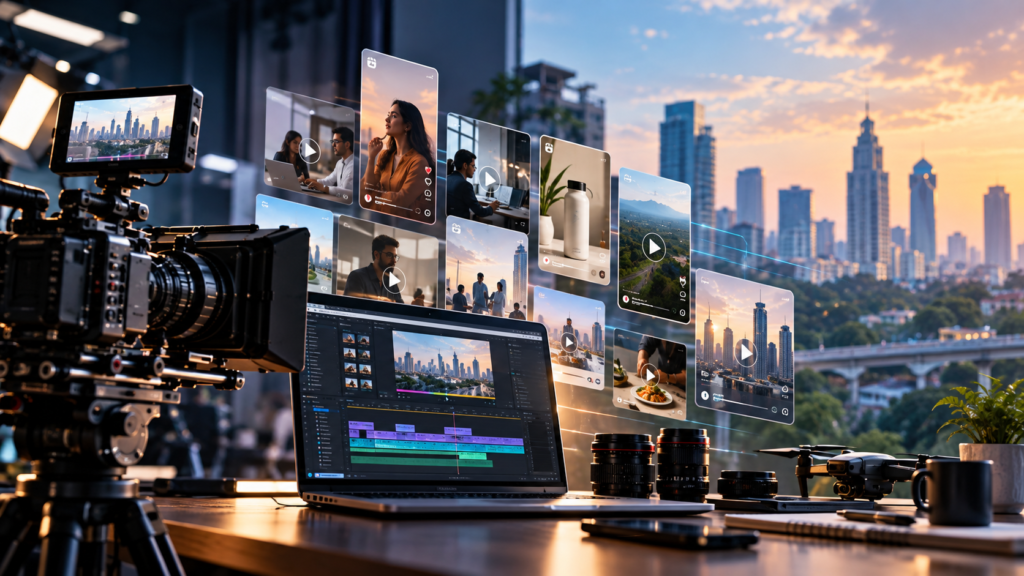
Video has moved far beyond being just another type of marketing content. In 2026, businesses are using video across almost every stage of the customer journey—from building brand awareness and explaining products to generating leads, supporting sales and engaging existing customers.
According to Wyzowl’s 2026 video marketing research, 91% of businesses use video as a marketing tool, while 93% of video marketers consider it an important part of their overall strategy. Social media videos are the most common type of video being created, followed by explainer videos, testimonials and video advertisements.
But the way businesses create and distribute video is changing.
For brands in Bangalore and across India, 2026 is increasingly about producing more relevant video, adapting content for different platforms, using AI intelligently and measuring business outcomes—not simply producing one polished brand film and publishing it once.
Here are the major video marketing trends businesses should watch in 2026.
1. Short-Form Video Continues to Dominate
Short-form video remains one of the most important formats for digital marketing in 2026.
Instagram Reels, YouTube Shorts and other vertical-video formats have changed how people discover brands, products and services.
Short videos can communicate an idea quickly, making them particularly useful for:
- Product launches
- Brand awareness
- Promotional campaigns
- Product demonstrations
- Customer testimonials
- Behind-the-scenes content
- Educational content
- Offers and announcements
- Paid advertising
Current 2026 marketing research continues to identify short-form video as one of the leading formats for ROI and engagement.
However, short-form does not mean low-quality.
The challenge is to combine strong storytelling, attention-grabbing visuals and concise messaging within a limited timeframe.
For businesses, the question is no longer simply “Do we need a video?”
It is increasingly:
“How can we create video content that captures attention in the first few seconds?”
2. AI Will Become Part of the Video Production Workflow
Artificial intelligence is changing video production, but it is not simply replacing traditional filmmaking.
In 2026, businesses and production teams are increasingly using AI to support tasks such as:
- Concept development
- Script ideation
- Storyboarding
- Research
- Video editing
- Caption generation
- Translation
- Subtitling
- Voice processing
- Content repurposing
- Personalization
- Production planning
Wyzowl’s 2026 research found that 63% of video marketers have used AI video tools to help create or edit marketing videos, up from 51% the previous year.
Wistia’s 2026 research similarly shows that businesses are increasingly incorporating AI into their video workflows, particularly during pre-production.
The important distinction is that AI should support the creative process rather than replace creative strategy.
A strong concept, script, cinematography, direction and brand understanding still determine whether a video actually communicates effectively.
3. One Video Shoot Will Produce Multiple Pieces of Content
Businesses are becoming more conscious of the cost and effort involved in producing professional video.
Instead of creating one three-minute corporate film and stopping there, brands can plan a production around multiple deliverables.
For example, one corporate shoot could produce:
1 Corporate Film
↓
5–10 Short Clips
↓
LinkedIn Videos
↓
Instagram Reels
↓
YouTube Shorts
↓
Employee/Recruitment Videos
↓
Website Content
↓
Paid Advertisement Creatives
This approach allows businesses to extract more value from a single production.
It also creates a more consistent visual identity across different marketing channels.
For a video production company in Bangalore, this means production planning increasingly needs to consider content distribution from the beginning, rather than treating social media versions as an afterthought.
4. Authentic Content Will Matter More Than Overly Polished Content
Professional production quality still matters, particularly for corporate films, advertising campaigns and premium brand content.
But audiences are also responding strongly to content that feels authentic.
This includes:
- Employee videos
- Founder videos
- Customer testimonials
- Behind-the-scenes footage
- Day-in-the-life content
- Product demonstrations
- Expert interviews
- Customer-generated content
- Creator-style videos
The result is an interesting balance.
Brands need professional production when the project demands it, while also creating content that feels natural and human.
The best strategy isn’t necessarily choosing between polished and authentic.
It is knowing when to use each style.
5. Vertical Video Is Becoming a Production Requirement
Traditional video production was often designed around the 16:9 landscape format.
That is no longer enough for many digital campaigns.
Brands now need to consider:
16:9 – YouTube, websites, presentations and traditional screens
9:16 – Instagram Reels, YouTube Shorts and other vertical platforms
1:1 – Certain social feeds and advertising placements
This means aspect ratios should be considered during production itself.
Camera framing, composition and subject positioning can all affect whether footage can be effectively repurposed into different formats.
Businesses planning a professional video production should therefore discuss multi-format deliverables before the shoot, rather than attempting to crop everything afterwards.
6. Video Series Are Replacing Some One-Off Campaigns
One of the biggest opportunities for brands in 2026 is moving from isolated videos to recurring content.
Instead of producing:
One video → Publish → Finished
businesses can create:
Episode 1 → Episode 2 → Episode 3 → Episode 4 → Episode 5
Possible series include:
- Founder stories
- Customer success stories
- Industry insights
- Product education
- Expert interviews
- Behind-the-scenes content
- Employee stories
- Frequently asked questions
- Product tips
- Educational series
A series gives audiences a reason to return and gives brands a repeatable content framework.
It can also make content planning easier for marketing teams.
7. Video Is Becoming an Important B2B Marketing Tool
Video marketing isn’t only for consumer brands.
B2B companies are increasingly using video for:
- Corporate communication
- Product demonstrations
- Case studies
- Client testimonials
- Recruitment
- Training
- Sales presentations
- LinkedIn marketing
- Investor communication
- Company profiles
For businesses in Bangalore’s technology, healthcare, manufacturing, real estate, education, finance and professional-services sectors, video can simplify complex information and make a company more approachable.
A well-produced corporate video can communicate what a company does, who it serves and what differentiates it far more effectively than a page of text.
8. Product Videos Will Play a Bigger Role in Online Buying
Customers increasingly want to understand products before making a purchase.
Product videos can demonstrate:
- How a product works
- Product features
- Product benefits
- Scale and dimensions
- Usage instructions
- Product quality
- Different use cases
Video is particularly useful when photographs alone cannot communicate how a product works.
Meta has also highlighted the growing role of short-form video in product discovery and shopping in India, describing the increasing “videofication” of shopping experiences.
For e-commerce brands, product video should therefore be considered part of the sales journey—not merely a branding exercise.
9. Silent-First Video Design Will Become More Important
Many people encounter social media videos while their device is muted.
That means videos need to communicate visually even when the viewer doesn’t immediately turn on the sound.
Businesses should consider:
- On-screen text
- Captions
- Strong visual storytelling
- Clear opening frames
- Visual demonstrations
- Simple messaging
- Strong composition
Sound remains extremely important for professional filmmaking, advertising and storytelling.
But social-first content should be designed so that the core message doesn’t disappear when the audio is turned off.
10. Storytelling Still Beats Technology
With AI tools becoming increasingly accessible, producing technically impressive visuals is becoming easier.
That makes storytelling even more important.
A business can have:
- The latest camera
- AI-generated visuals
- Advanced VFX
- Professional lighting
- High-resolution footage
and still produce an ineffective video if there is no compelling story.
A strong video should answer:
Why should the audience care?
This is particularly important for advertising films and corporate videos.
Instead of simply listing features, businesses should focus on the problem, emotion, transformation or outcome that matters to the audience.
Technology can improve production.
Storytelling creates connection.
11. Video Performance Will Be Measured More Seriously
Views are no longer enough.
Businesses are increasingly looking at metrics such as:
- Watch time
- Completion rate
- Engagement
- Click-through rate
- Leads
- Website traffic
- Sales
- Conversions
- Customer retention
- Brand awareness
Wyzowl’s 2026 research shows that marketers use a combination of views, engagement, leads, customer engagement and sales to evaluate video performance.
This shift means production and marketing teams need to work together.
A video should be created with a clear objective.
For example:
Brand Awareness → Reach + Views + Recall
Lead Generation → Clicks + Leads
Product Marketing → Engagement + Product Understanding
Sales → Conversions + Revenue
The right measurement depends on what the video is designed to accomplish.
12. Businesses Will Demand More Content From Every Production
Marketing teams need a constant flow of content.
This creates pressure to produce more without continuously increasing production budgets.
Wistia’s 2026 State of Video report found that video demand is increasing while many companies are keeping budgets relatively flat.
The answer is not necessarily producing cheaper videos.
It is creating a smarter production system.
That could mean:
- Batch shooting
- Reusable sets
- Content series
- Multiple aspect ratios
- Multiple edits from one shoot
- AI-assisted post-production
- Template-based content
- Repurposing long-form footage
- Planning content calendars around production days
This approach can help businesses maintain quality while increasing content output.
What Do These Video Marketing Trends Mean for Businesses in Bangalore?
Bangalore is home to startups, technology companies, multinational corporations, e-commerce brands, real estate companies, educational institutions, healthcare businesses and many other industries.
For these businesses, video can serve different purposes—from corporate communication and recruitment to advertising, product marketing and social media.
But simply producing more videos isn’t necessarily the answer.
Businesses should focus on building a video content ecosystem.
For example:
A Corporate Shoot
Could become:
- 1 Corporate Film
- 3 Executive Interviews
- 5 Employee Stories
- 10 LinkedIn Clips
- 10 Instagram Reels
- 5 Recruitment Videos
- Several website videos
This turns one production into an ongoing content asset.
How MediaClub Helps Businesses Use Video in 2026
MediaClub is a video production and creative company based in Bengaluru, working with brands across India, the UK and UAE.
The company says it has delivered 6,000+ successful video productions and provides an end-to-end production workflow covering pre-production, filming, post-production and delivery.
MediaClub’s production capabilities include:
- Corporate Films
- Brand Films
- Ad Films
- Product Videos
- Commercial Photography
- Documentary Films
- Video Editing
- Motion Graphics
- VFX
- Digital Content
For businesses looking for video production services in Bangalore, the ability to develop content for multiple platforms can be particularly valuable.
A corporate production, for example, can be planned not only for a website or presentation but also for LinkedIn, YouTube, Instagram and paid advertising.
Final Thoughts
The biggest video marketing trend of 2026 isn’t a particular platform, camera or AI tool.
It is the shift toward strategic, scalable and purpose-driven video content.
Short-form video will continue to attract attention. AI will make parts of production faster. Authentic content will help brands connect with audiences. Vertical formats will become increasingly important. And businesses will expect greater value from every production.
But one principle remains unchanged:
Great video starts with a great idea.
Businesses that combine strong storytelling with professional production, platform-specific content and measurable marketing objectives will be better positioned to make video a meaningful part of their marketing strategy in 2026.
If your business is planning a corporate film, brand film, product video, advertisement or social media video campaign in Bangalore, working with an experienced production partner can help turn the idea into content that works across multiple channels.
Explore MediaClub’s video production services and start planning your next project.